I live across the street from a bar that attracts many bikers from all over the city. I don't know if bikers are generally concerned about how they are viewed in the eyes of non-bikers, but the bikers who patronize this particular neighborhood bar do nothing to endear the motorcycle culture to my heart. Mainly because they insist on letting their bikes idle forever, and then rev the engines so loudly that I can *feel* them from the couch!
Ewan McGregor and Charley Boorman have, though, given me insight into the passion people can have for motorcycles. I have a new appreciation -not that I ever want to ride one- after watching the documentaries of their bike trips around the world. In 2004, they rode from London to New York and called the trip The Long Way Round. In 2007, they rode from John O'Groats, Scotland to Cape Town and called the trip The Long Way Down. The documentaries are brilliant - they use cameras on their helmets, handheld cameras and travel with a camera man to record everything - encounters with wild animals, border crossings, meals with people they meet along the way - and while the landscape, faces, houses, beliefs, lifestyles change drastically as they travel east, there are enough commonalities that make the world seem like not that big a place after all.
While there are many things that I love about what they experience (including their work with UNICEF), one thing I noticed in the credits was a long list of 'fixers.' In general, fixers help travelers (including journalists and foodies) navigate border crossings, cultural differences, security concerns, translation needs etc. Charley and Ewan sometimes travel into the countries with their fixer, but most often get the skinny on the condition of roads, learn about places to eat and stay, and must-sees.
Fixers don't handle everything, of course. There are many scenes as the team prepares for the trip of the producers gathering essential documents, visiting embassies and meeting with advisors in London, and trips to the Royal Geographical Society (I love all the maps). In addition to passports and visas for the crew for every country, they needed carnets (customs documents) for the video equipment, and a few other documents.
(Oh, and speaking of documentation, tomorrow is Passport Day in the USA. Seriously, there is a day, week, or month, for everything!)
3.27.2009
3.20.2009
A renaissance to call my own
I've rediscovered the love of fresh vegetables. Like the proverbial wholesome 'boy next door' that you've known your whole life but never gave much thought to and all of a sudden realize is perfect, vegetables have always had an unassuming presence and over the last few years I've realized that they're perfect.
I was a little lazy about food in my early twenties. I ate out whenever possible, and prepared many a frozen or boxed meal. I went to Farmer's Markets and shopped at The Wedge because it was fashionable, not because I thought the produce was better or because I was excited about cooking with whatever was in season, or because I was truly happy to buy local. Over the last few years a combination of circumstances and events have affected my attitude toward preparing meals.
I think I first heard about CSA (Community Supported Agriculture) farms a few years ago from my relatives in California. We've got a few friends who have received boxes of vegetables from their local CSA farm on a weekly basis and have loved it. The DH and I have talked about it for a few years, but this is the year that we're finally going to get on board. Especially since I found a farm that grows a number of heirloom varieties!
I'm looking forward to it. I'm looking forward to cooking with vegetables that I don't normally cook with, and I'm looking forward to (possibly) preserving some of the extras to enjoy at a later date. I hope that this cooking kick I'm on is more than just a kick, and that we'll use this to the fullest.
I was a little lazy about food in my early twenties. I ate out whenever possible, and prepared many a frozen or boxed meal. I went to Farmer's Markets and shopped at The Wedge because it was fashionable, not because I thought the produce was better or because I was excited about cooking with whatever was in season, or because I was truly happy to buy local. Over the last few years a combination of circumstances and events have affected my attitude toward preparing meals.
- Turning 30, which triggers the realization that your body actually does better when you take care of it;
- A raised collective awareness of living 'green,' which includes buying local and organic;
- Michael Pollan's In Defense of Food, and his simple premise (Eat Food. Not too much. Mostly plants.) resonated with me as I stared at my 'high-fiber' (read: highly processed) breakfast bars);
- Discovering the joy of heirloom vegetables, including a mild and sweet heirloom tomato and the most amazing heirloom carrot soup at Farm.
- Realizing that homemade vegetable stock is actually not difficult to make (the Moosewood recipe is my fave) and tastes better; and
- I have a decent kitchen, finally.
I think I first heard about CSA (Community Supported Agriculture) farms a few years ago from my relatives in California. We've got a few friends who have received boxes of vegetables from their local CSA farm on a weekly basis and have loved it. The DH and I have talked about it for a few years, but this is the year that we're finally going to get on board. Especially since I found a farm that grows a number of heirloom varieties!
I'm looking forward to it. I'm looking forward to cooking with vegetables that I don't normally cook with, and I'm looking forward to (possibly) preserving some of the extras to enjoy at a later date. I hope that this cooking kick I'm on is more than just a kick, and that we'll use this to the fullest.
3.14.2009
There's more?
The DH and I started geocaching last summer, but the fall and winter got in the way of our outings. Friends of ours recently got into it, and that renewed our enthusiasm for getting out there and getting more finds under our belt. That, and it's finally spring-like.
As I was updating our profile and logging today's find* at geocaching.com, I started to look through the various types of caches that are available now. Geocaching is high-tech scavenger hunting. With easy (and relatively cheap) access to the multi-billion dollar global positioning system in the form of a GPS device, one uses a set of navigational coordinates to locate hidden canisters, tins, tupperware containers, etc. At least, that's the case with a traditional cache.
There are two (new to me) types of caches that really excite me, and that don't require us to bring along our Dora The Explorer hair ties to trade in for other trinkets. An EarthCache is "a special place that people can visit to learn about a unique geoscience feature or aspect of our Earth." In Minnesota you can find, for example, glacier remains like The Whale's Tale in the northeastern part of the state, or limestone caves in the southeastern part. Some other types of EarthCaches include thermal springs in Idaho, possible meteorite collisions with Wisconsin and many other sites around the globe. What a great way to get to some these sites that may be quite close but that we don't know much about or don't take time to learn about them. WayMarks are "interesting and useful locations around the world," that should be somewhat out of the ordinary. WayMarks are manmade, and include museums, interesting headstones, painted barn quilts, and Carnegie Library buildings to name a few.
Why search for Carnegie library buildings or volcanoes with a set of coordinates and a GPS device, rather than an address and a map? Not having sought these types of caches out (yet), all I can say is that the pleasurable part of geocaching for us is the hunt, the exercise, and the joy of getting off the beaten path and finding hidden away places we might not have otherwise explored. So, if geocaching just happens to be coupled with finding cool mineral deposits or non-coastal boardwalks, I'm game.
I don't think I have to say this, but the lists on Earthcaching.com and Waymarking.com aren't comprehensive lists or subject matter authorities (although the GSA approves EarthCaches). Just a great way to get coordinates from someone else who took the time to mark them.
*When I say today's find, I mean the DH's find. He did the actual digging around for great hiding spots, while I slow-poked along behind him with the GPS and pointed at things. I'm still healing from a recent surgery and was just happy to get outside and walk more than a block and a half.
As I was updating our profile and logging today's find* at geocaching.com, I started to look through the various types of caches that are available now. Geocaching is high-tech scavenger hunting. With easy (and relatively cheap) access to the multi-billion dollar global positioning system in the form of a GPS device, one uses a set of navigational coordinates to locate hidden canisters, tins, tupperware containers, etc. At least, that's the case with a traditional cache.
There are two (new to me) types of caches that really excite me, and that don't require us to bring along our Dora The Explorer hair ties to trade in for other trinkets. An EarthCache is "a special place that people can visit to learn about a unique geoscience feature or aspect of our Earth." In Minnesota you can find, for example, glacier remains like The Whale's Tale in the northeastern part of the state, or limestone caves in the southeastern part. Some other types of EarthCaches include thermal springs in Idaho, possible meteorite collisions with Wisconsin and many other sites around the globe. What a great way to get to some these sites that may be quite close but that we don't know much about or don't take time to learn about them. WayMarks are "interesting and useful locations around the world," that should be somewhat out of the ordinary. WayMarks are manmade, and include museums, interesting headstones, painted barn quilts, and Carnegie Library buildings to name a few.
Why search for Carnegie library buildings or volcanoes with a set of coordinates and a GPS device, rather than an address and a map? Not having sought these types of caches out (yet), all I can say is that the pleasurable part of geocaching for us is the hunt, the exercise, and the joy of getting off the beaten path and finding hidden away places we might not have otherwise explored. So, if geocaching just happens to be coupled with finding cool mineral deposits or non-coastal boardwalks, I'm game.
I don't think I have to say this, but the lists on Earthcaching.com and Waymarking.com aren't comprehensive lists or subject matter authorities (although the GSA approves EarthCaches). Just a great way to get coordinates from someone else who took the time to mark them.
*When I say today's find, I mean the DH's find. He did the actual digging around for great hiding spots, while I slow-poked along behind him with the GPS and pointed at things. I'm still healing from a recent surgery and was just happy to get outside and walk more than a block and a half.
3.13.2009
Post-op
Now that it's over and I'm healing nicely, I've got a list of the fascinating-to-me aspects of my recent gallbladder surgery.
- Thrombo Embolus Deterrent (T.E.D.) stockings are anti-embolism compression stockings that go up to mid-thigh, and are worn to keep circulation going in the legs during surgery. Basically, they're designed to prevent blood clots in the legs. They are quite comfortable, actually, and I would suggest to the tummy tucker industry that they use the same material. I was commenting on how comfortable they are to the nurse who brought me out of the hospital, and she said I could keep them. I declined. But they are available at Walgreens.
- I was given some kind of sedation medicine for the ride down to the OR that made everything very fuzzy. The nurse anesthetist commented on how relaxed I was to begin with, but said that they administer it to reduce anxiety and that it has an amnesia effect. I was secretly excited to see the inside of the operating room to compare it to ORs on television, so I made a deliberate effort to stay awake until I got to the operating room. I remember going through the doors, and then looking up to see the huge lights above the operating table.
My girl Amanda pointed out that it was quite wise of the hospital to make sure that the lights were off! Otherwise my last image would have been the proverbial light. - In laparoscopic gallbladder surgery, the abdomen is inflated with carbon dioxide. It goes in through an incision in the belly button, and gives the surgeon room to move around in there, and also keeps things dry.
Now, gas rises. The carbon dioxide escapes through the shoulders.
When I woke up in the recovery ward, my shoulders ached like they hadn't ached before. The feeling resembled muscle tension, but it wasn't the same. I was nicely medicated, so the sensation was never more than an ache, but it was about 18 hours before I noticed the shoulders feeling better.
The helium balloon effect also took hold. My voice was quite raspy for a day! - Thankfully, I'm healing well. And I'm thankful that my body has good communication skills. Before the surgery I wondered when I will be able to walk any distances, when I will be able to work out again, when I will be able to [fill in the blank]. And each day my body tells me when I'm ready to do something again, and when an activity is too much. The four incisions are small, but I still have to let the abdominal muscles recover.
- I was canker sores galore for about five days after the surgery. I had between 6-7 mouth sores on my soft palate and uvula. The nurses said that it was not a common reaction to being intubated, and weren't sure they were directly related to the surgery. It's hard to know if it was a coincidence, but I'm certain there was a connection. It's also hard to know what caused them (was it bacteria from my front tooth? was it stress? was it an allergic reaction to something? was it irritation from the intubation? a combination of the above?) but what finally worked for me (after trying Cloraseptic, salt water, etc.,) was Benadryl tablets. Some other remedies include hydrogen peroxide and a mouth rinse of liquid Benadryl and Milk of Magnesia.
3.12.2009
Get Rid of [problem] once and for all
You know how in meetings or new groups the facilitator usually has everyone introduce themselves by sharing a unique or memorable fact? I HATE that. I hate it because I'm usually stumped for an answer. I don't have the wherewithal in the heat of the moment to follow Veronica's lead by quoting lyrics and saying something like "My name is Katherine. I once shot a man, in Reno, just to watch him die." So I end up saying something completely lame.
On my first day of graduate school, the professor had us take something out of our bags and tell our new classmates what that something said about us. Seriously, my choices were a brand new Mead notebook or a pen from Boeing that lit up. I went with the pen, and said that it represented my interest in many things, including illumination and the history of and principles of flight. I think this brief episode sticks out in my memory because I was nervous about starting something new, and was at that moment especially thankful to have set boundaries within which to be creative.
I started this blog for several reasons. I wanted to improve my writing speed. I wanted a creative outlet of some sort. I wanted to participate in Web 2.0 and blogging was an element I could jump into with relative ease. I wanted to record strange or recurring reference transactions.
And I still get these things out of keeping this blog.
Although the topics I post about are quite varied, the scope (things "everyone seems to know but me") is quite specific, and I'm not inspired by that any longer. Plus, my other interests don't fit in. Quilting doesn't fit. Book reviews don't fit. Geocaching doesn't fit. Professional library stuff doesn't fit. Geek stuff doesn't fit.
I like having set parameters. I like thesis statements to support. I like mission statements to adhere to. I like rules to bend. I like having margins, even if I doodle in them. If I know the limits, I can respond to them and be creative within them. If the scope of...anything...remains undefined, I get lost. And flustered.
I follow certain bloggers who are strangers to me because I'm interested in the topics they blog about, and if they get too far off topic I usually stop following. If book bloggers start sharing too many scary neighbor stories, I tend to lose interest. If foodies started blogging about their computer problems, I would unfollow until they got a mac and got back on topic. I follow friends and family because I care about them and what they have to say, but everyone there sticks to their intentions for their blogs too.
So, where does that leave me? (Besides alone. Is anyone still reading?) I see three options. 1) I can start over with a new blog to capture the topics that don't fit Oranges and Peaches. The Katmosphere? Alpha Kat? Kat's Cradle? Nine Lives of Kat? 2) I can create a series of blogs, one for each community I would like to take part in. That would be exhausting, but dashboards on Blogger and Wordpress are handy. Besides, who has six blogs? Moreover, who wants to bookmark six blogs? 3) I could redefine my vision for Oranges and Peaches. After all, I like the name.
I'm going to open curtain number three. Dear Readers (Hi, Mom!), I'm banking on the fact that you aren't attached to the 'common knowledge' angle for this blog, because I intend to include posts about quilting, reading, public librarianship, geocaching, and anything else that catches my eye. At least for awhile.
And, I know I could have just started posting other things without going through this whole rant, but I think I needed to establish this for myself. Or give myself permission to move on to a new description. Or something.
On my first day of graduate school, the professor had us take something out of our bags and tell our new classmates what that something said about us. Seriously, my choices were a brand new Mead notebook or a pen from Boeing that lit up. I went with the pen, and said that it represented my interest in many things, including illumination and the history of and principles of flight. I think this brief episode sticks out in my memory because I was nervous about starting something new, and was at that moment especially thankful to have set boundaries within which to be creative.
I started this blog for several reasons. I wanted to improve my writing speed. I wanted a creative outlet of some sort. I wanted to participate in Web 2.0 and blogging was an element I could jump into with relative ease. I wanted to record strange or recurring reference transactions.
And I still get these things out of keeping this blog.
Although the topics I post about are quite varied, the scope (things "everyone seems to know but me") is quite specific, and I'm not inspired by that any longer. Plus, my other interests don't fit in. Quilting doesn't fit. Book reviews don't fit. Geocaching doesn't fit. Professional library stuff doesn't fit. Geek stuff doesn't fit.
I like having set parameters. I like thesis statements to support. I like mission statements to adhere to. I like rules to bend. I like having margins, even if I doodle in them. If I know the limits, I can respond to them and be creative within them. If the scope of...anything...remains undefined, I get lost. And flustered.
I follow certain bloggers who are strangers to me because I'm interested in the topics they blog about, and if they get too far off topic I usually stop following. If book bloggers start sharing too many scary neighbor stories, I tend to lose interest. If foodies started blogging about their computer problems, I would unfollow until they got a mac and got back on topic. I follow friends and family because I care about them and what they have to say, but everyone there sticks to their intentions for their blogs too.
So, where does that leave me? (Besides alone. Is anyone still reading?) I see three options. 1) I can start over with a new blog to capture the topics that don't fit Oranges and Peaches. The Katmosphere? Alpha Kat? Kat's Cradle? Nine Lives of Kat? 2) I can create a series of blogs, one for each community I would like to take part in. That would be exhausting, but dashboards on Blogger and Wordpress are handy. Besides, who has six blogs? Moreover, who wants to bookmark six blogs? 3) I could redefine my vision for Oranges and Peaches. After all, I like the name.
I'm going to open curtain number three. Dear Readers (Hi, Mom!), I'm banking on the fact that you aren't attached to the 'common knowledge' angle for this blog, because I intend to include posts about quilting, reading, public librarianship, geocaching, and anything else that catches my eye. At least for awhile.
And, I know I could have just started posting other things without going through this whole rant, but I think I needed to establish this for myself. Or give myself permission to move on to a new description. Or something.
2.25.2009
We applied the cortical electrodes
A standard test given at pre-op appointments is the EKG (electrocardiogram, where the k comes from I don't know) which measures the electrical activity of the heartbeat. The information is useful to determine how well the heart is beating, and whether parts of the heart are larger than other parts. The electrodes themselves, in my case, were disposable stickers that were applied to my ankles, arms and chest. They don't deliver any electricity, they just record and transmit electrical activity. After the electrodes were attached, the test itself took a half minute (since it was basic. There are many other reasons to have an EKG, and the test itself can be more involved).
Now, provided nothing is expected to be wrong, it could be just another experience in a lab. BUT! To Firefly fans, EKGs are just shiny in that they provide the perfect opportunity to quote Jayne.
*****
Simon: What about the cortical electrodes?
Jayne: Oh! (pause) Uh, we forgot 'em.
*****
Jayne: (After being told to bring the DOAs to the morgue, determined to deliver the line he worked so hard to memorize) We applied the cortical electrodes but where unable to get a neural reaction from either patient.
*****
Watch the full episode here.
Now, provided nothing is expected to be wrong, it could be just another experience in a lab. BUT! To Firefly fans, EKGs are just shiny in that they provide the perfect opportunity to quote Jayne.
*****
Simon: What about the cortical electrodes?
Jayne: Oh! (pause) Uh, we forgot 'em.
*****
Jayne: (After being told to bring the DOAs to the morgue, determined to deliver the line he worked so hard to memorize) We applied the cortical electrodes but where unable to get a neural reaction from either patient.
*****
Watch the full episode here.
2.24.2009
Naturally intelligent
"It's not how smart you are, but how you are smart."
I attended a workshop yesterday that presented ways to implement Gardner's Theories of Multiple Intelligences and Goleman's Emotional and Social Intelligence research in programming for elementary age children. We didn't cover the intelligences in depth, or their many many possible applications (and neither will I here). Whether or not this research holds any weight in the world (and, I believe it does), I did leave with some great programming ideas, a better vocabulary set to understand and focus my work with kids, and validation of my instincts and hunches.
There is one intelligence that was new to me, and has been...well...bothering me a little bit. Gardner says that we all have access to all eight intelligences, though to varying degrees, and that they are equally important. The eight, as he has identified, are:
People learn best when a meaningful connection is made, so it makes sense to me that for the kinesthetically intelligent among us, the pairing of movement and learning has a better chance of making that meaningful connection. With the first seven I can more readily think ways to extend a topic to tap into the intelligences, to encourage connections to be made in different ways. And (I found out) I do already.
Naturalist? There's a program called Paws to Read that brings trained therapy dogs into the library and allows children to practice reading aloud to a nonthreatening audience. That's the best example that I know of that I can think of. Experiences in nature are more stimulating for those who have heightened naturalist intelligence, so the next time my book clubs suggest having the discussion outside on a nice day, I will jump at the opportunity to stimulate this intelligence.
Link Love
Howard Gardner: Hobbs Professor of Cognition and Education at the Harvard Graduate School of Education, and author of Frames of Mind (1983) that introduced the Theory of Multiple Intelligences
Multiple Intelligences Assessment (I'm strongest in self, followed by spatial then nature) and Engaging the Intelligences
Multiple Intelligences and Childhood Development: a nice checklist of traits associated with each intelligence in both children and adults
Multiple Intelligences Research and Consulting: just as it sounds
New Horizons: neuroscience articles that are actually easy to read
I attended a workshop yesterday that presented ways to implement Gardner's Theories of Multiple Intelligences and Goleman's Emotional and Social Intelligence research in programming for elementary age children. We didn't cover the intelligences in depth, or their many many possible applications (and neither will I here). Whether or not this research holds any weight in the world (and, I believe it does), I did leave with some great programming ideas, a better vocabulary set to understand and focus my work with kids, and validation of my instincts and hunches.
There is one intelligence that was new to me, and has been...well...bothering me a little bit. Gardner says that we all have access to all eight intelligences, though to varying degrees, and that they are equally important. The eight, as he has identified, are:
- Linguistic (learn best by reading)
- Logical-Mathematical (learn best with numbers and logic) (not me, by the way)
- Spatial (visual learners -- think in pictures)
- Bodily-Kinesthetic (learn best with physical experiences)
- Musical (learn best in tempo and pitch)
- Interpersonal ("people smart")
- Intrapersonal ("self smart")
- Naturalist ("to understand the natural world including plants, animals and scientific studies")
People learn best when a meaningful connection is made, so it makes sense to me that for the kinesthetically intelligent among us, the pairing of movement and learning has a better chance of making that meaningful connection. With the first seven I can more readily think ways to extend a topic to tap into the intelligences, to encourage connections to be made in different ways. And (I found out) I do already.
Naturalist? There's a program called Paws to Read that brings trained therapy dogs into the library and allows children to practice reading aloud to a nonthreatening audience. That's the best example that I know of that I can think of. Experiences in nature are more stimulating for those who have heightened naturalist intelligence, so the next time my book clubs suggest having the discussion outside on a nice day, I will jump at the opportunity to stimulate this intelligence.
Link Love
Howard Gardner: Hobbs Professor of Cognition and Education at the Harvard Graduate School of Education, and author of Frames of Mind (1983) that introduced the Theory of Multiple Intelligences
Multiple Intelligences Assessment (I'm strongest in self, followed by spatial then nature) and Engaging the Intelligences
Multiple Intelligences and Childhood Development: a nice checklist of traits associated with each intelligence in both children and adults
Multiple Intelligences Research and Consulting: just as it sounds
New Horizons: neuroscience articles that are actually easy to read
2.22.2009
Fun with balls...
...quilted balls filled with cotton balls, or (as I call them) quilted cotton balls.
 A friend pointed recommended that I try some of the patchwork puzzle balls from Jinny Beyer's book for a small project to have on hand while recovering from surgery (still a few weeks out). I was intrigued by the size and shape of the balls, and couldn't wait to try them out! I ended up putting my current project on hold for a few nights while I try some of the patterns.
I was looking for ways to use scraps from previous projects already, but the appeal these patterns held for me was the mathematics behind each pattern. Not that I'm a math whiz or anything, but it was very smart for Beyer to describe how to traditional patterns are reworked so they form a sphere. I was also looking forward to using and practicing with templates, which is something I had been putting off.
The filling is pure cotton. Beyer recommends a particular brand of cotton fill, but I just used cotton balls. The filling needs to be cotton, as other material is not dense enough to hold the shape, but given that I don't really have a use for quilted cotton balls, I wasn't about to spend money on quality cotton. I did unroll and separate (almost) every cotton ball before stuffing the sphere to reduce lumpiness, but I assume a higher quality cotton wouldn't be as lumpy as my balls are.
I haven't quite figured out a use for quilted cotton balls, though. The smaller one is now a basketball for a friend, and the larger is a catnip toy for my cats. That's enough, right?

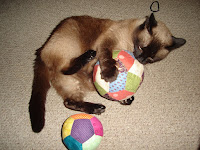

 A friend pointed recommended that I try some of the patchwork puzzle balls from Jinny Beyer's book for a small project to have on hand while recovering from surgery (still a few weeks out). I was intrigued by the size and shape of the balls, and couldn't wait to try them out! I ended up putting my current project on hold for a few nights while I try some of the patterns.
I was looking for ways to use scraps from previous projects already, but the appeal these patterns held for me was the mathematics behind each pattern. Not that I'm a math whiz or anything, but it was very smart for Beyer to describe how to traditional patterns are reworked so they form a sphere. I was also looking forward to using and practicing with templates, which is something I had been putting off.
The filling is pure cotton. Beyer recommends a particular brand of cotton fill, but I just used cotton balls. The filling needs to be cotton, as other material is not dense enough to hold the shape, but given that I don't really have a use for quilted cotton balls, I wasn't about to spend money on quality cotton. I did unroll and separate (almost) every cotton ball before stuffing the sphere to reduce lumpiness, but I assume a higher quality cotton wouldn't be as lumpy as my balls are.
I haven't quite figured out a use for quilted cotton balls, though. The smaller one is now a basketball for a friend, and the larger is a catnip toy for my cats. That's enough, right?


2.10.2009
Questo gelato è squisito!
The DH and I stopped into a gelato parlor on our walk from Pike Place Market to Pioneer Square, and happened to follow a group of children on a field trip into the place. (I would have loved field trips like that when I was young!) They were asking tons of questions about the gelato, and because my attention was focused on the quilt shop I spotted across the way, I hardly paid any attention to the answers. At some point in my life I knew what the difference between gelato and ice cream was, but I had to look it up again.
As About.com explains it, because gelato is made with whole milk (rather than cream) and churned at a slower rate, it has less fat and less air than American ice cream which allows for the intensity of the flavor. It is also typically served warmer than ice cream. Non-dairy varieties (sorbet, sorbetto) are typically made from fruit, suger and water, and are delicious and creamy as well.
I haven't found gelato in the twin cities area since Caruso's left Calhoun Square, but I'm definitely going to give Giulia's Italian Ice Cream near the University of Minnesota a try, and I'll keep my eye out for Ciao Bella gelati and sorbetti in the co-ops. Or, I could make another trip to Portland (gelato is everywhere!) or better yet, Italy.
As About.com explains it, because gelato is made with whole milk (rather than cream) and churned at a slower rate, it has less fat and less air than American ice cream which allows for the intensity of the flavor. It is also typically served warmer than ice cream. Non-dairy varieties (sorbet, sorbetto) are typically made from fruit, suger and water, and are delicious and creamy as well.
I haven't found gelato in the twin cities area since Caruso's left Calhoun Square, but I'm definitely going to give Giulia's Italian Ice Cream near the University of Minnesota a try, and I'll keep my eye out for Ciao Bella gelati and sorbetti in the co-ops. Or, I could make another trip to Portland (gelato is everywhere!) or better yet, Italy.
2.09.2009
Hatch Show Prints
 One of the exhibits at the Experience Music Project in Seattle, and the one I was most geeked about when I visited recently, is the Hatch Show Prints collection. The Hatch brothers started printing advertisements in the late 1800s, and continued to design posters for various industries throughout the 1900s through today. The prints were made using hand-crafted wood blocks, many of which were displayed at the exhibit in Seattle. As anyone who has gone to the Renaissance Festival with me knows, I love getting up close to anything printing press related, and this was n
 o different. I could have spent hours staring at the details in the giant wood blocks, and did spend a lot of time going back and forth between the wood blocks and the prints themselves.
I love the simple aesthetic of the prints, too, with simple color schemes, straight lines and big letters. It's much easier to go wild with design with digital tools -- not so much when you're carving your design into wood and putting one color on the print at a time.
 If I ever find myself accidentally in Nashville, I'll be okay. I have something I want to do, and that is visit the Hatch print shop. Today it's a working letterpress/museum/archive/tourist attraction.
2.03.2009
Is it just me, or is 2009 more expensive?
Expense Number One: Gallbladder surgery
I had a gallbladder attack in December (or, so I was thinking as I was collapsed on the floor in the staff room at work with pain radiating around my torso and trying not to vomit) and an ultrasound confirmed that I have multiple gallstones. For many women gallstones will go unnoticed, but for me -- I have the curse of the family gallbladder. Causes of gallstone formation are not known exactly -or they're not easy to explain to laypeople- but bile and cholesterol are most likely involved, and stored bile can become too viscous. Stones can be blasted, but surgical removal is the only way to guarantee that the stones won't come back. They can get stuck in a duct and cause other complications, so I'm convinced this is something that has to be done.
Expense Number Two: Basement Remodel
I'm excited about having the basement remodeled. I have a disgusting 100 year old basement, and a staircase that is not in good shape. The stairs definitely needed to be redone, and having the work done on the destination (i.e., the basement) will give us new and more space in the house. It was a nerve-wracking, yet easy decision to make.
It's also been a bit of a challenge, and I have learned the lesson yet again to trust my instincts. We're working with a reputable company, but I was a bit frustrated with the designer/salesman with the way he smoothed over details with us and didn't seem to hear us in October when we said that we wanted the work done in February. I wrote it off as my not knowing how to react to schmoozers, but his lack of attention to detail is staring me in the face in the form of cracked walls upstairs after his recommendation to remove load-bearing posts to make way for the concrete. The support beams (one was bowing, and as it turns out, rotting - but the main one needed to stay) were not incorporated into his plans, I think.
Expense Number Three: Flooding in the Pacific Northwest
We had a lovely vacation to Portland and Seattle in early January. I had booked everything through hotwire.com, and knew that it wouldn't be flexible when I booked flights, hotels and rental car at great rates, but I wasn't planning on changing plans. The plan was to fly into Seattle, drive to Portland, and then drive back up to Seattle via the Oregon Coast. Lovely, right?
Unfortunately, I-5 (the ONLY way to get between Seattle and Portland by car) was flooded. The main purpose for the trip was to visit our people in Portland, so we ended up flying (the purchase of the one-way tickets meant automatic pat-down from the TSA) and getting a ride back to Seattle. We left the original, pre-paid car in Seattle and rented a different one when we got back for the same price. We also had to forgo the pre-paid hotel in Seaside. Sadness. The lesson taught is that it can be better to work with a travel agent. You never know when you're going to be flooded in, or need to change plans for any reason.
And just a note -- I think anyone who reads this blog knows that lack of posting doesn't mean I've fallen off the face of the Earth. My way of dealing with the stress of extra expenses and the general displeasures of winter is to quilt, read, dork around on facebook and watch BSG. So I'm not blogging as often.
I had a gallbladder attack in December (or, so I was thinking as I was collapsed on the floor in the staff room at work with pain radiating around my torso and trying not to vomit) and an ultrasound confirmed that I have multiple gallstones. For many women gallstones will go unnoticed, but for me -- I have the curse of the family gallbladder. Causes of gallstone formation are not known exactly -or they're not easy to explain to laypeople- but bile and cholesterol are most likely involved, and stored bile can become too viscous. Stones can be blasted, but surgical removal is the only way to guarantee that the stones won't come back. They can get stuck in a duct and cause other complications, so I'm convinced this is something that has to be done.
Expense Number Two: Basement Remodel
I'm excited about having the basement remodeled. I have a disgusting 100 year old basement, and a staircase that is not in good shape. The stairs definitely needed to be redone, and having the work done on the destination (i.e., the basement) will give us new and more space in the house. It was a nerve-wracking, yet easy decision to make.
It's also been a bit of a challenge, and I have learned the lesson yet again to trust my instincts. We're working with a reputable company, but I was a bit frustrated with the designer/salesman with the way he smoothed over details with us and didn't seem to hear us in October when we said that we wanted the work done in February. I wrote it off as my not knowing how to react to schmoozers, but his lack of attention to detail is staring me in the face in the form of cracked walls upstairs after his recommendation to remove load-bearing posts to make way for the concrete. The support beams (one was bowing, and as it turns out, rotting - but the main one needed to stay) were not incorporated into his plans, I think.
Expense Number Three: Flooding in the Pacific Northwest
We had a lovely vacation to Portland and Seattle in early January. I had booked everything through hotwire.com, and knew that it wouldn't be flexible when I booked flights, hotels and rental car at great rates, but I wasn't planning on changing plans. The plan was to fly into Seattle, drive to Portland, and then drive back up to Seattle via the Oregon Coast. Lovely, right?
Unfortunately, I-5 (the ONLY way to get between Seattle and Portland by car) was flooded. The main purpose for the trip was to visit our people in Portland, so we ended up flying (the purchase of the one-way tickets meant automatic pat-down from the TSA) and getting a ride back to Seattle. We left the original, pre-paid car in Seattle and rented a different one when we got back for the same price. We also had to forgo the pre-paid hotel in Seaside. Sadness. The lesson taught is that it can be better to work with a travel agent. You never know when you're going to be flooded in, or need to change plans for any reason.
And just a note -- I think anyone who reads this blog knows that lack of posting doesn't mean I've fallen off the face of the Earth. My way of dealing with the stress of extra expenses and the general displeasures of winter is to quilt, read, dork around on facebook and watch BSG. So I'm not blogging as often.
1.26.2009
Whachamacallits
Yes, I am about to use the words 'vocabulary' and 'fun' in the same sentence....
What a fun vocabulary list!
The girl cat keeps chewing on my aglets.
Ikea keeps putting up new bollards.
Dingbats and censorship go hand in hand.
You're obviously having ferrule issues, so use this eraser.
The keeper broke, but luckily, I can just use my pants.
I can't think of a time that I would ever need to know what a kerf is.
I was told the bigger the punt the better the wine.
My husband and I have matching scars on our philtrums.
As the day gets longer/more frustrating, I see more and more phosphenes.
Whatever you do, don't pierce your tragus.
What a fun vocabulary list!
The girl cat keeps chewing on my aglets.
Ikea keeps putting up new bollards.
Dingbats and censorship go hand in hand.
You're obviously having ferrule issues, so use this eraser.
The keeper broke, but luckily, I can just use my pants.
I can't think of a time that I would ever need to know what a kerf is.
I was told the bigger the punt the better the wine.
My husband and I have matching scars on our philtrums.
As the day gets longer/more frustrating, I see more and more phosphenes.
Whatever you do, don't pierce your tragus.
1.22.2009
Tea time
The DH and I popped into a tea room at the Chinese Gardens in Portland, and were met with the most amazing aromas from all the different teas that were brewing. We had the option of ordering a traditional ceremonial presentation with our tea (and I still wish we'd splurged a bit!) but we were happy with the gaiwan teas that we did drink.
 Gaiwan refers to both a traditional Chinese method of brewing tea, and the cup/lid/saucer used to brew the tea. The leaves are brewed in the cup, and the lid is used to strain the tea by holding the leaves in. We just drank our tea directly from the cup, but if you're worried about the stray leaf working its way into your mouth, it could be poured into a separate cup.
 Gaiwan refers to both a traditional Chinese method of brewing tea, and the cup/lid/saucer used to brew the tea. The leaves are brewed in the cup, and the lid is used to strain the tea by holding the leaves in. We just drank our tea directly from the cup, but if you're worried about the stray leaf working its way into your mouth, it could be poured into a separate cup.
1.06.2009
They have a name for it
The idea that maintaining a city's cleanliness and quality of life helps to keep the crime rate low is called the broken windows theory. And! It's apparently been called this since the 80s, when George Kelling and James Wilson wrote an article called Broken Windows for The Atlantic in 1982.
I've been mildly curious about cities that build their policies around this principle to reduce crime since I first heard about about the transit authority cleaning up the graffiti in New York subways in the 90s, among the many additional efforts made thereafter. There has been some experimentation and a lot of debate about its effectiveness (pro and con) over the years, as well as alternative explanations for the drop in crime in NYC. The same types of questions are being asked in Minneapolis, where the theory has been put into practice.
There are probably multiple factors that go into the crime rate, and I for one don't think anything can be attributed to one factor or practice alone. But, that's more than I want to write about today. Today, I'm just glad to have a name for it.
Except to add that I stumbled across this great discussion starter about how the theory applies to social networking sites. I hadn't ever really thought about it, but as much time as I spend online, I don't use a huge variety of sites, and my personal experience with online vandalism is limited to comment spam.
I've been mildly curious about cities that build their policies around this principle to reduce crime since I first heard about about the transit authority cleaning up the graffiti in New York subways in the 90s, among the many additional efforts made thereafter. There has been some experimentation and a lot of debate about its effectiveness (pro and con) over the years, as well as alternative explanations for the drop in crime in NYC. The same types of questions are being asked in Minneapolis, where the theory has been put into practice.
There are probably multiple factors that go into the crime rate, and I for one don't think anything can be attributed to one factor or practice alone. But, that's more than I want to write about today. Today, I'm just glad to have a name for it.
Except to add that I stumbled across this great discussion starter about how the theory applies to social networking sites. I hadn't ever really thought about it, but as much time as I spend online, I don't use a huge variety of sites, and my personal experience with online vandalism is limited to comment spam.
1.05.2009
Not a black and white issue
 On election day, 2008, we held our own election at the reference desk for a library mascot. It was our way to a) harness election day energy for ourselves, b) have something fun for kids to participate in (and it turned out, fun for the adults) and c) to deflect any political discussion that patrons might have wanted to engage in. (As much as I had to say that day, I could not and did not want to engage in discussion at work).
Panda won by one vote.
The display in the lobby has prompted occasional discussion about pandas at the reference desk during the last month.
- Pandas are part of the Ursidae (bear) family, not the Procyonidae (raccoon) family. This is the subject of much debate, but DNA and molecular makeup put Giant Pandas closer to bears. However, scientists have not yet agreed on which family the red panda belongs to.
- Pandas are not marsupials, and koalas are not technically bears.
- Explanations for the unique black and white markings offered over the years include camouflage and extreme sorrow, and the reason why pandas in the wild and the zoo don't appear black and white is that they are not natural self-groomers, and they get dirty!
- Bamboo (the main staple in a panda's diet) flooring isn't necessarily the most 'green' option available.
1.04.2009
Tiresome woes
I work with the public. And, for the most part, I really love it.
The oddities and neediness of people can try my patience from time to time, and I have had to develop strategies for dealing with those...quirks. One of my strategies, for example when people get particularly worked up over not knowing how to use a web browser or a computer mouse and take it out on me, is to remember that I hate having to deal with car problems. Hate. I'm completely at the mercy of others.
Last month, on a particularly snowy morning, we were all driving to breakfast and I was noticing (oh, okay...whining) that my car seemed to be slipping and sliding more than the others. I don't know who said that maybe it was time for new tires, but the rest of the conversation went like this:
A few years ago I picked up a free tread depth gauge at an expo, but came to realize that a) I only used it once which did little good, and b) I used it incorrectly anyway. Consumer Reports says that treads should cover George Washington's hairline on a quarter, and Car Bibles: The Wheel and Tire has a great visual on how to check the treads of the tire, along with advice on tire pressure gauges, rotation schedules, mileage warranties, explanations of the markings along the side of the tire, and all sorts of things that...just...made my eyes glaze over.
I had new tires within two weeks of this discovery, and I was really glad to have them last night while driving home in the freezing rain. NOW, I have to figure out whether I should and how I go about getting new windshield wiper blades...Ugh.
So. The effort it takes me to figure out this basic car stuff helps me in the end. It helps me maintain patience when working with the public.
That's my story, and I'm sticking to it.
The oddities and neediness of people can try my patience from time to time, and I have had to develop strategies for dealing with those...quirks. One of my strategies, for example when people get particularly worked up over not knowing how to use a web browser or a computer mouse and take it out on me, is to remember that I hate having to deal with car problems. Hate. I'm completely at the mercy of others.
Last month, on a particularly snowy morning, we were all driving to breakfast and I was noticing (oh, okay...whining) that my car seemed to be slipping and sliding more than the others. I don't know who said that maybe it was time for new tires, but the rest of the conversation went like this:
Mom: How many miles do you have on your tires, anyway?So. The general rule is that tires should be replaced every 40,000 miles or six years, but since tires can wear out before that, inspect them regularly.
Me: Ummm...let me see...92,500
Mom: KAT! You should have had new tires 50,000 miles ago!!!
Me: Oh. (Instant stress. Convinced we were going to be stranded downtown forever. Completely mute. Oh, okay. Fine. Every other sentence was something about the tires. Possibly every sentence.)
A few years ago I picked up a free tread depth gauge at an expo, but came to realize that a) I only used it once which did little good, and b) I used it incorrectly anyway. Consumer Reports says that treads should cover George Washington's hairline on a quarter, and Car Bibles: The Wheel and Tire has a great visual on how to check the treads of the tire, along with advice on tire pressure gauges, rotation schedules, mileage warranties, explanations of the markings along the side of the tire, and all sorts of things that...just...made my eyes glaze over.
I had new tires within two weeks of this discovery, and I was really glad to have them last night while driving home in the freezing rain. NOW, I have to figure out whether I should and how I go about getting new windshield wiper blades...Ugh.
So. The effort it takes me to figure out this basic car stuff helps me in the end. It helps me maintain patience when working with the public.
That's my story, and I'm sticking to it.
1.03.2009
A silver lining
I was reading through the feeds in my Google Reader account that I have tagged 'word nerds' and came across yesterday's OED Word of the Day: argentine.
That's right. Lower case a.
Lower case argentine, I came to learn, means silver, material simulating silver, or made or or containing silver. This is not to be confused with Argentine people of Argentina, even though Argentina got its name from the Latin argentum, meaning silver. And it's never to be confused with Argentinian, because Argentinian is not really the way to refer to people from Argentina.
I've always enjoyed saying Argentine out loud. Something about the soft 'g' coming after the r, perhaps. However, I will be saying argentine from now on.
That's right. Lower case a.
Lower case argentine, I came to learn, means silver, material simulating silver, or made or or containing silver. This is not to be confused with Argentine people of Argentina, even though Argentina got its name from the Latin argentum, meaning silver. And it's never to be confused with Argentinian, because Argentinian is not really the way to refer to people from Argentina.
I've always enjoyed saying Argentine out loud. Something about the soft 'g' coming after the r, perhaps. However, I will be saying argentine from now on.
1.02.2009
Confession: I don't know everything I should
Obviously. But specifically, I don't know the American Girls very well.
In fact, I have gotten by with knowing very little about them* except that they are the highly merchandised dolls from different time periods of American history that each have their own series of six books (with additional shorter stories published along the way), clothes and, well, just lots of other accessories and paraphernalia.
But. I should know their names and when and where they're from. In particular, I should have recognized the references I've been hearing to Kit Kittredge, the depression-era girl now portrayed by Abigail Breslin in the movie. The movie that came out six months ago. And, I come to find out that television movies were made of Molly, Felicity and Samantha as well.
I need a cheat sheet.
Kaya (1764) is a Native American girl with an Appaloosa mare who learns the traditional ways of her people, the Nez Perce of the Pacific Northwest.
Felicity Merriman (1774) lives in Williamsburg, Virgina right before the American Revolution. She has both patriots and loyalists in her family, and has a good friend named Elizabeth. (This is tricky for me, when patrons ask about the Girls' counterparts). She also has a horse in her life, a copper-red mare.
Josephina Montoya (1824) is a Hispanic girl who lives on a ranch in (what is now) New Mexico (it wasn't part of the States at this point in history), and is influenced heavily by her aunt, Tia Dolores. .
Kirsten Larsen (1854) immigrates to a farm in Minnesota from Sweden and must learn the language, the customs and what have you.
Addy Walker (1864) and her family are slaves on a plantation in North Carolina just near the end of the Civil War. Desperate to be free, she and her mother escape to the free city of Philadelphia.
Samantha Parkington (1904) is an orphan with a wealthy grandmother who wants her to be a proper girl, and is paired with her friend Nellie, a servant girl.
Kit Kittregde (1934) lives in Cincinnati just as The Great Depression is affecting the lives of everyone around her, including her family.
Molly McIntire (1944) helps with the efforts of World War II, as do her parents (father a doctor sent to England, mother a volunteer with the Red Cross). She's paired with Emily, a refugee from England who stays with the family.
Julie Albright (1974) is a child of the 70s living near Chinatown in San Francisco struggling with her parents' divorce. Her best friend is Ivy, a Chinese girl.
Not to mention the Girl of the Year series that features girls in America today.
For more info that I (and most likely you) want, check out
KidsReads.com The American Girls Collection
The American Girl Historical Characters online store (with good visuals)
About.com's Women's History books for preteens
Well. This whole thing started when I was wondering who the heck Kit Kittredge was. Joan Freese at MinnPost aksed who knew Kit would be so hot right now? Well, not me. But now I do.
*In my defense, patrons tend to ask for the books by title, or by series name, and they tend to refer to the first name of the girl only. Also, the AG came along after the point in my childhood where I would have been interested, and the fever broke before I came on board as a librarian. I don't have kids in my life who are the age for the AG, and the times I would walk by the store in Chicago or the new store in the Mall of America I usually think to myself a) this is madness or b) I would have gone nuts over a Babysitters Club store when I was the age. But, knowing how interested I am in history now, I probably would have loved these girls when I was young.
In fact, I have gotten by with knowing very little about them* except that they are the highly merchandised dolls from different time periods of American history that each have their own series of six books (with additional shorter stories published along the way), clothes and, well, just lots of other accessories and paraphernalia.
But. I should know their names and when and where they're from. In particular, I should have recognized the references I've been hearing to Kit Kittredge, the depression-era girl now portrayed by Abigail Breslin in the movie. The movie that came out six months ago. And, I come to find out that television movies were made of Molly, Felicity and Samantha as well.
I need a cheat sheet.
Kaya (1764) is a Native American girl with an Appaloosa mare who learns the traditional ways of her people, the Nez Perce of the Pacific Northwest.
Felicity Merriman (1774) lives in Williamsburg, Virgina right before the American Revolution. She has both patriots and loyalists in her family, and has a good friend named Elizabeth. (This is tricky for me, when patrons ask about the Girls' counterparts). She also has a horse in her life, a copper-red mare.
Josephina Montoya (1824) is a Hispanic girl who lives on a ranch in (what is now) New Mexico (it wasn't part of the States at this point in history), and is influenced heavily by her aunt, Tia Dolores. .
Kirsten Larsen (1854) immigrates to a farm in Minnesota from Sweden and must learn the language, the customs and what have you.
Addy Walker (1864) and her family are slaves on a plantation in North Carolina just near the end of the Civil War. Desperate to be free, she and her mother escape to the free city of Philadelphia.
Samantha Parkington (1904) is an orphan with a wealthy grandmother who wants her to be a proper girl, and is paired with her friend Nellie, a servant girl.
Kit Kittregde (1934) lives in Cincinnati just as The Great Depression is affecting the lives of everyone around her, including her family.
Molly McIntire (1944) helps with the efforts of World War II, as do her parents (father a doctor sent to England, mother a volunteer with the Red Cross). She's paired with Emily, a refugee from England who stays with the family.
Julie Albright (1974) is a child of the 70s living near Chinatown in San Francisco struggling with her parents' divorce. Her best friend is Ivy, a Chinese girl.
Not to mention the Girl of the Year series that features girls in America today.
For more info that I (and most likely you) want, check out
KidsReads.com The American Girls Collection
The American Girl Historical Characters online store (with good visuals)
About.com's Women's History books for preteens
Well. This whole thing started when I was wondering who the heck Kit Kittredge was. Joan Freese at MinnPost aksed who knew Kit would be so hot right now? Well, not me. But now I do.
*In my defense, patrons tend to ask for the books by title, or by series name, and they tend to refer to the first name of the girl only. Also, the AG came along after the point in my childhood where I would have been interested, and the fever broke before I came on board as a librarian. I don't have kids in my life who are the age for the AG, and the times I would walk by the store in Chicago or the new store in the Mall of America I usually think to myself a) this is madness or b) I would have gone nuts over a Babysitters Club store when I was the age. But, knowing how interested I am in history now, I probably would have loved these girls when I was young.
1.01.2009
Saving sand dollars
If you live in Minneapolis you probably knew this already...but there are actually snow shoveling rules. I knew it was against the law to shovel snow into the streets and alleyways, and I knew it was our responsibility to clear snow after a fall, but I guess I thought it the courteous and right thing to do to shovel as soon as possible. But, I just discovered that we residential folk have 24 hours after the snowfall to complete the snow and ice removal. Or else, I guess. (That's a long time. It's best to shovel sooner than that -- packed snow is hard to shovel and leads to ice buildup which is even worse to remove).
I don't even know how I came across that city site -- probably reading through MinnPost or MNSpeak -- but the cool thing I discovered, and the reason I'm even blogging about this at all, is that residents of Minneapolis can pick up free sand for their sidewalks. And, there's a pickup spot just blocks from our piece of sidewalk!
I'm feeling a bit too excited about this, in a free-sand-isn't-worthy-of-this-much-attention-so-get-over-it kind of way. But, we've had a snowy winter so far, and I always seem to run out of ice melt at the most inopportune moments.
I don't even know how I came across that city site -- probably reading through MinnPost or MNSpeak -- but the cool thing I discovered, and the reason I'm even blogging about this at all, is that residents of Minneapolis can pick up free sand for their sidewalks. And, there's a pickup spot just blocks from our piece of sidewalk!
I'm feeling a bit too excited about this, in a free-sand-isn't-worthy-of-this-much-attention-so-get-over-it kind of way. But, we've had a snowy winter so far, and I always seem to run out of ice melt at the most inopportune moments.
12.31.2008
Goodbye 2008, I hardly knew ye
Time.com does a nice job of year-in-review stuff, for example, and obviously people can find what they're interested in on their own, so I recognize that this is not a major contribution to the blogosphere, but I la la love the reviewing at the end of each year. So....
Speaking of Time... their top awkward moment (Bush dancing while waiting to endorse McCain) is pretty funny, and their ninth (but my top) political line is Colin Powell endorsing Obama on Meet the Press and saying "is there something wrong with being a Muslim in this country?"
Words of the Year include hypermiling (New Oxford American Dictionary), bailout (M-W), overshare (Webster's New World), and meh (me). The American Dialect Society will announce its word in early 2009, but it looks like the word will be change.
Minnesota Shopping Center Association Awards (yes, such an award exists...) go to Best Buy in Mall of America for redesign, SuperTarget in Southdale for design and aesthetics and many others. Sheesh. And the only non-metro prize was awarded in Mankato.
Best New Bars of the cities include moto-i, Barrio and Seven Sushi. I do not get out much. Never even heard of these. Hmmm...maybe now is the time to start a New Year's resolution to get to these places...
Minneapolis, economically, ranked 137 out of 200 in The Best Performing Cities of 2008, according to the Milken Institute, but tied for first place with Seattle as being the most literate city of 2008.
Best Books of the Year for adults that I have read include The Guernsey Literary and Potato Peel Pie Society, by Mary Ann Shaffer, Away, by Amy Bloom, Anathem, by Neal Stephenson, Persuasion, by Jane Austen, The Three Musketeers, by Alexandre Dumas and The Mayor of Casterbridge, by Thomas Hardy.
Best Books of the Year for teens that I have read include The Absolutely True Diary of a Part Time Indian, by Sherman Alexie, Paper Towns, by John Green, Little Brother, by Cory Dotorow, and Sweethearts, by Sara Zarr.
Best Books of the Year that I intend to read include Books: a memoir, by Larry McMurtry and The Girl with the Dragon Tattoo, by Steig Larsson (Library Journal), The Elegance of the Hedgehog, by Muriel Barbery (Washington Post), Olive Kitteridge, by Elizabeth Strout (The Atlantic), The Plague of Doves, by Louise Erdrich (CS Monitor) and 2666, by Roberto Bolaño (NYT), and City of Bones, by Cassandra Clare (Teens Top Ten, because I've read the others).
Two of the five things we learned from Michelle Bachmann are the truth about the Declaration of Independance: 'Guess what? Not all cultures are equal!' and the geography of the Alaskan National Wildlife Refuge: 'dark most of the year' and 'no trees' courtesy of the Uncommon Loon Awards from Minnesota Montly Magazine.
How To 2008: How to do almost anything with social media is a great resource to keep on hand. Especially for those who are new to things like Google Reader, or for those who decide to join Twitter.
Sad and too-early farewells include Heath, Tim, and local blogger Emilie Lemmons.
Speaking of Time... their top awkward moment (Bush dancing while waiting to endorse McCain) is pretty funny, and their ninth (but my top) political line is Colin Powell endorsing Obama on Meet the Press and saying "is there something wrong with being a Muslim in this country?"
Words of the Year include hypermiling (New Oxford American Dictionary), bailout (M-W), overshare (Webster's New World), and meh (me). The American Dialect Society will announce its word in early 2009, but it looks like the word will be change.
Minnesota Shopping Center Association Awards (yes, such an award exists...) go to Best Buy in Mall of America for redesign, SuperTarget in Southdale for design and aesthetics and many others. Sheesh. And the only non-metro prize was awarded in Mankato.
Best New Bars of the cities include moto-i, Barrio and Seven Sushi. I do not get out much. Never even heard of these. Hmmm...maybe now is the time to start a New Year's resolution to get to these places...
Minneapolis, economically, ranked 137 out of 200 in The Best Performing Cities of 2008, according to the Milken Institute, but tied for first place with Seattle as being the most literate city of 2008.
Best Books of the Year for adults that I have read include The Guernsey Literary and Potato Peel Pie Society, by Mary Ann Shaffer, Away, by Amy Bloom, Anathem, by Neal Stephenson, Persuasion, by Jane Austen, The Three Musketeers, by Alexandre Dumas and The Mayor of Casterbridge, by Thomas Hardy.
Best Books of the Year for teens that I have read include The Absolutely True Diary of a Part Time Indian, by Sherman Alexie, Paper Towns, by John Green, Little Brother, by Cory Dotorow, and Sweethearts, by Sara Zarr.
Best Books of the Year that I intend to read include Books: a memoir, by Larry McMurtry and The Girl with the Dragon Tattoo, by Steig Larsson (Library Journal), The Elegance of the Hedgehog, by Muriel Barbery (Washington Post), Olive Kitteridge, by Elizabeth Strout (The Atlantic), The Plague of Doves, by Louise Erdrich (CS Monitor) and 2666, by Roberto Bolaño (NYT), and City of Bones, by Cassandra Clare (Teens Top Ten, because I've read the others).
Two of the five things we learned from Michelle Bachmann are the truth about the Declaration of Independance: 'Guess what? Not all cultures are equal!' and the geography of the Alaskan National Wildlife Refuge: 'dark most of the year' and 'no trees' courtesy of the Uncommon Loon Awards from Minnesota Montly Magazine.
How To 2008: How to do almost anything with social media is a great resource to keep on hand. Especially for those who are new to things like Google Reader, or for those who decide to join Twitter.
Sad and too-early farewells include Heath, Tim, and local blogger Emilie Lemmons.
Subscribe to:
Posts (Atom)